
The 1930s Beauty Cream That Promised Glowing Skin With Radioactive Ingredients
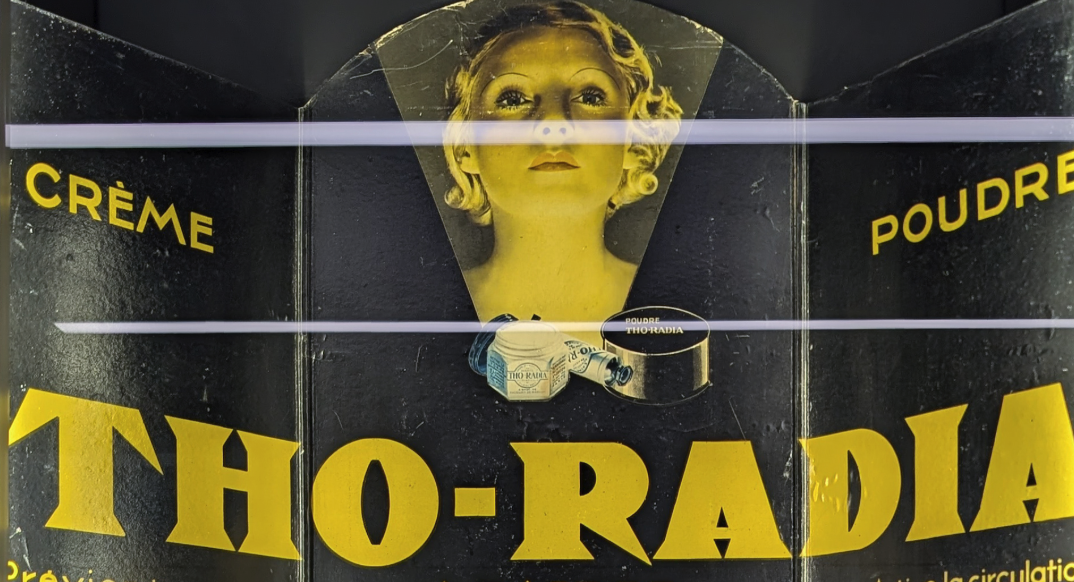
In 1933, a striking advertisement began appearing in French pharmacies and magazines. It featured a glamorous woman whose face seemed to glow from beams of golden light rising from two cosmetic jars.
The product was called Tho-Radia, and its promise was extraordinary: beautiful, youthful-looking skin through the power of radioactivity.
Unlike many beauty products of the era that simply borrowed scientific-sounding names, Tho-Radia’s original face cream really did contain radioactive substances. Its formula included thorium chloride and radium bromide — elements that had once been celebrated as scientific marvels.

The brand claimed its products could stimulate circulation, firm facial tissues, reduce excess oil and help fight wrinkles. And it wasn’t selling from some questionable street stall. Tho-Radia was available through pharmacies, with packaging and advertising designed to look every bit as sophisticated as the beauty products of its time.
There was another unusual detail behind the brand. Its formula was attributed to a doctor named Alfred Curie, whose surname carried an unmistakable association with one of the most famous scientific families in history.
There was just one problem: he wasn’t related to them.
When Radioactivity Became a Beauty Trend
To understand how radioactive face cream became a fashionable purchase, it helps to look at the extraordinary reputation radium had acquired by the early 20th century.
When Marie and Pierre Curie discovered radium in 1898, the element fascinated scientists and the public alike. It emitted energy seemingly on its own, and its unusual properties made it one of the most exciting scientific discoveries of the era.
Early research also revealed that radiation could have medical applications, including the treatment of certain cancers.
But public enthusiasm quickly went much further. If radiation could help destroy diseased cells, some entrepreneurs reasoned, perhaps small amounts could also invigorate healthy ones.
By the 1920s, radioactivity had become a marketing sensation. Companies began selling everything from radioactive drinking water and patent medicines to toothpaste, cosmetics and other everyday products. Some products merely traded on the fashionable association with radium; others genuinely contained radioactive ingredients.
Beauty companies were particularly quick to embrace the trend. Products promised rejuvenated skin, improved circulation and a youthful complexion, all supposedly backed by the latest scientific discoveries.
Tho-Radia would become one of the most recognizable examples of this unusual beauty craze.
The Pharmacist Behind Tho-Radia Had a Clever Marketing Idea
The man behind the business was Alexis Moussalli, a pharmacist born in Cairo in 1894 who later worked in Paris.
Moussalli was fascinated by radioactive formulations. Historical research credits him with patenting more than 100 preparations involving radium or radioactive compounds between 1927 and 1934.
But creating an unusual formula was only part of the challenge. To sell a premium beauty product, he needed something equally valuable: credibility.
That’s where Dr. Alfred Curie entered the picture.
Alfred Curie was a real Parisian physician, not an entirely invented advertising character. He had completed medical training, worked as a hospital physician and later operated a private practice.
However, he had no known family connection to Marie and Pierre Curie, the scientists whose research had made the surname internationally famous.
In November 1932, Alfred Curie registered the Tho-Radia trademark and authorized the company to advertise its products as being made according to his formula.
The name was a marketing gift. Consumers encountering a radioactive beauty product associated with a doctor named Curie could easily assume a connection to the famous scientific family.
The real Curie family reportedly considered legal action over the potential confusion, although the dispute does not appear to have reached court.
Whether Alfred Curie personally developed the formula or primarily lent his medical credentials and name to the venture remains uncertain.
The Advertisements Made Radioactivity Look Glamorous
Tho-Radia’s success wasn’t built on scientific claims alone. Its advertising was remarkably sophisticated.
One of its most memorable campaigns featured artwork attributed to French illustrator Tony Burnand. The now-famous image showed a woman illuminated from below by dramatic beams of light. Two Tho-Radia products sat beneath her face, creating the impression that the jars themselves were responsible for her radiant appearance.
It was an ingenious visual metaphor. Radioactivity, something invisible and poorly understood by most consumers, became a symbol of beauty and modernity.
The company’s promotional material leaned heavily into the language of science. Tho-Radia described its products as a scientific beauty method and claimed its cream could activate circulation, firm facial tissues, remove excess oil and help prevent wrinkles.
The company also expanded beyond its signature face cream. Its product range eventually included face powder, rouge, beauty milk, soap, lipstick and toothpaste. Customers could build an entire beauty routine around the brand.
For a generation fascinated by modern science, the idea of using an advanced radioactive formula as part of a daily skincare routine apparently had considerable appeal.
Yes, the Cream Really Contained Radium
Here’s where Tho-Radia’s story becomes considerably more disturbing.
Many products from the wider radium craze used radioactive language primarily as a selling point. Tho-Radia’s original face cream, however, was genuinely radioactive.
A 1932 laboratory analysis recorded the following ingredients in 100 grams of the cream:
- 0.5 grams of thorium chloride
- 0.233 micrograms of radium bromide
The face powder also contained radioactive compounds, including thorium sulfate and a smaller quantity of radium bromide.
The distinction matters because the brand’s advertising wasn’t entirely inventing its scientific credentials. It really was selling cosmetics containing radioactive substances.
There is an important historical footnote here: the radium quantity has sometimes been reproduced incorrectly as 0.233 milligrams. The ORAU Museum of Radiation and Radioactivity explains that the original laboratory figure was 0.233 micrograms, not milligrams.
The museum’s records also distinguish the original radioactive products from later Tho-Radia cosmetics. Some products sold in the 1940s and 1950s, including lipstick and blush, were not measurably radioactive.
Read the ORAU Museum’s examination of surviving Tho-Radia products.

Image: Tho-Radia advertising and products containing thorium and radium, photographed at the Musée Curie in Paris. Image source and license, by The wub, CC BY-SA 4.0.The Warning Signs Were Already There
By the time Tho-Radia appeared in French pharmacies, the dangers of radium were no longer entirely unknown.
Scientists and researchers had experienced radiation injuries firsthand. Pierre Curie had deliberately exposed his arm to radium, resulting in a painful sore that took months to heal.
The most notorious warning came from the American workers who became known as the Radium Girls.
In the 1910s and 1920s, young women employed in watch factories painted luminous watch dials using radium-based paint. They were often instructed to sharpen their paintbrushes with their lips, unknowingly ingesting radioactive material in the process.
Because radium behaves chemically like calcium, the body can deposit it in bones. The consequences for many of these workers were devastating, including severe bone damage, cancers and premature deaths.

Image: Women working at a United States Radium Corporation factory in 1922. Image source. The file is identified as public domain on Wikimedia Commons; check the file page for current rights information.
Then came another highly publicized case.
American industrialist Eben Byers became famous for drinking Radithor, a radioactive patent medicine that promised health benefits. He reportedly consumed around 1,400 bottles over several years.
Byers eventually suffered catastrophic damage to his jaw and other bones. He died in March 1932, and his case became one of the most infamous examples of the dangers of radioactive consumer products.

Image: A surviving bottle of Radithor, the radioactive patent medicine associated with Eben Byers. Image source and license.jpg), CC BY-SA 2.0.His death received widespread attention. Yet just eight months later, Tho-Radia’s trademark was registered in Paris.
The contrast is difficult to ignore: while the dangers of radium were becoming increasingly apparent, a beauty company was still turning it into a selling point.
France Cracked Down, and Tho-Radia Quietly Changed Its Formula
The radioactive beauty craze couldn’t last forever.
In 1937, France introduced restrictions on the non-medical use of radioactive substances, making it increasingly difficult to sell products containing radium and thorium as ordinary consumer goods.
For Tho-Radia, this created an obvious problem. Its signature selling point was suddenly becoming a regulatory liability.
The company responded by removing the radioactive ingredients from its products.
But rather than abandoning its established identity, it kept the Tho-Radia name.
The brand also moved away from its earlier association with Dr. Alfred Curie. References to his formula disappeared from its packaging and advertising.
In other words, the company abandoned the very ingredients that had inspired its name while preserving the brand recognition those ingredients had helped create.
It was an extraordinary marketing pivot.
The Brand Survived for Decades Without the Radium
You might expect a company associated with radioactive cosmetics to disappear after such a dramatic change. Tho-Radia did not.
Its products continued to be sold after the reformulation, and the brand enjoyed a postwar revival in France.
Even more remarkably, some of its recognizable advertising imagery continued to appear in the following decades.
The company increasingly presented itself as a conventional beauty brand, promoting a scientific approach to skincare without the radioactive ingredients that had originally made it famous.
By the 1960s, however, competition and changing consumer tastes had caught up with the business. Tho-Radia eventually disappeared as a commercial brand.
Its legacy survived in museum collections, vintage advertisements and historical research documenting one of the strangest chapters in the history of cosmetics.
A Beauty Trend That Sounds Almost Impossible Today
Tho-Radia’s story is a reminder of just how differently people once viewed scientific progress.
In the early 20th century, radioactivity represented modernity, discovery and the promise of a healthier future. Businesses quickly learned that attaching a product to a fashionable scientific breakthrough could make it seem more sophisticated and desirable.
The beauty industry was particularly receptive to these promises.
Today, radioactive face cream sounds like something invented for a horror movie. But in 1930s France, it was a real product, sold through ordinary pharmacies and promoted with some of the era’s most striking commercial artwork.
And perhaps the strangest part isn’t that Tho-Radia once contained radium.
It’s that the company managed to keep selling beauty products for years after taking it out.
Sources and Further Reading
- ORAU Museum of Radiation and Radioactivity — Tho-Radia Items — surviving products, laboratory figures, Alfred Curie and the 1937 reformulation.
- Musée Curie — Tho-Radia advertising triptych, circa 1933 — museum catalogue record for a historical advertising display.
- Wikimedia Commons — 1935 Tho-Radia advertisement — advertisement published in Cinémagazine, February 14, 1935.
- Wikimedia Commons — Tho-Radia products at the Musée Curie — modern photograph of historical products and advertising.
- NIST — New Jersey’s ‘Radium Girls’ and the scientist who came to their aid — historical context on the dial painters.
- Wikimedia Commons — Radium Girls photographs — historical images and individual file information.
- Wikimedia Commons — Radithor bottle.jpg) — surviving bottle and image licensing details.
- U.S. Food and Drug Administration — 80 Years of the Federal Food, Drug, and Cosmetic Act — background on the 1938 U.S. law.
Editorial image note: Images are embedded from Wikimedia Commons and linked to their file-description pages. Verify each license, attribution requirement and commercial-use permission before publication. The Musée Curie catalogue also specifies separate conditions for image reuse; a catalogue page being publicly viewable does not mean its image is free for commercial publication.


